ADSS live-line installation is uniquely enabled by all-dielectric construction:
Key Takeaway: Yes — ADSS fiber optic cable can be installed on energized (live) overhead power lines without a planned outage. This capability is a fundamental advantage of the all-dielectric (no metal) construction. Unlike OPGW or conventional aerial cables with metallic strength members, ADSS contains zero conductive elements — no aluminum, no steel, no copper. There is no risk of the cable becoming energized, no need for bonding or grounding, and no induced current hazard to installation crews. However, live-line ADSS installation still demands rigorous compliance with electrical safety clearances, use of insulated tools and equipment within the Minimum Approach Distance (MAD), and specific hardware selection to prevent electrostatic discharge damage during the installation phase. This article provides the critical safety framework, step-by-step installation protocol, and expert warnings that every field supervisor should enforce.
Why ADSS Is Safe for Live-Line Installation
Three properties make ADSS cable uniquely suited to live-line work:
- All-dielectric construction: The cable consists of glass (optical fiber), polymer (aramid yarn, loose tubes, jacket), and water-blocking materials — none of which conduct electricity. In standard operating conditions up to 500 kV, the cable cannot energize, short-circuit, or create a ground fault path.
- No grounding required: Metallic aerial cables (e.g., OPGW, figure-8 with steel messenger) must be bonded and grounded at every pole to prevent induced voltage buildup. ADSS eliminates this entire work stream, reducing installation time by 30–40%.
- Dielectric strength of jacket: The PE or AT jacket provides an insulation barrier rated for thousands of volts per millimeter. Even under wet, polluted surface conditions, the cable does not provide a conductive path capable of sustaining fault current.
Minimum Approach Distance (MAD): The Non-Negotiable Rule
While ADSS cannot become energized, the energized phase conductors above it certainly are. All personnel, tools, and equipment must maintain the regulatory Minimum Approach Distance from live conductors at all times during installation.
| System Voltage | MAD (OSHA/NFPA 70E, meters) | MAD (IEC 61472, meters) | Typical ADSS Attachment Zone |
|---|---|---|---|
| ≤1 kV (low-voltage) | Avoid contact | 0.1 | Below LV conductors |
| 1–15 kV | 0.7 | 0.7 | 0.5–1.0 m below lowest phase |
| 15–36 kV | 0.8 | 0.9 | 1.0–1.5 m below lowest phase |
| 36–72.5 kV | 1.0 | 1.2 | 1.5–2.0 m below lowest phase |
| 110–220 kV | 1.8–2.6 | 2.0–3.0 | 2.5–4.0 m below lowest phase |
| 330–500 kV | 3.3–4.5 | 3.7–5.0 | Requires E-field simulation |
Critical: Always verify local regulations. Some jurisdictions impose more conservative MAD values than OSHA or IEC. Never rely solely on this table — consult the controlling utility’s Live Line Manual.
Step-by-Step Live-Line Installation Protocol
Pre-Installation (Day Before)
- Job briefing: All crew members review the route, identify every crossing and obstruction, confirm MAD for the line voltage, and sign the JSA (Job Safety Analysis).
- Weather check: Do not proceed in rain, fog, or high humidity (>85% RH). Moisture reduces the dielectric strength of air and can cause flashover at reduced distances.
- Equipment inspection: Verify all insulated tools (hot sticks, insulating gloves, dielectric footwear) have valid test certificates. Inspect pay-out equipment for metal burrs that could damage the cable jacket.
During Installation
- Establish exclusion zone: Mark the MAD radius from the nearest phase conductor at each pole. No person or uninsulated tool enters this zone.
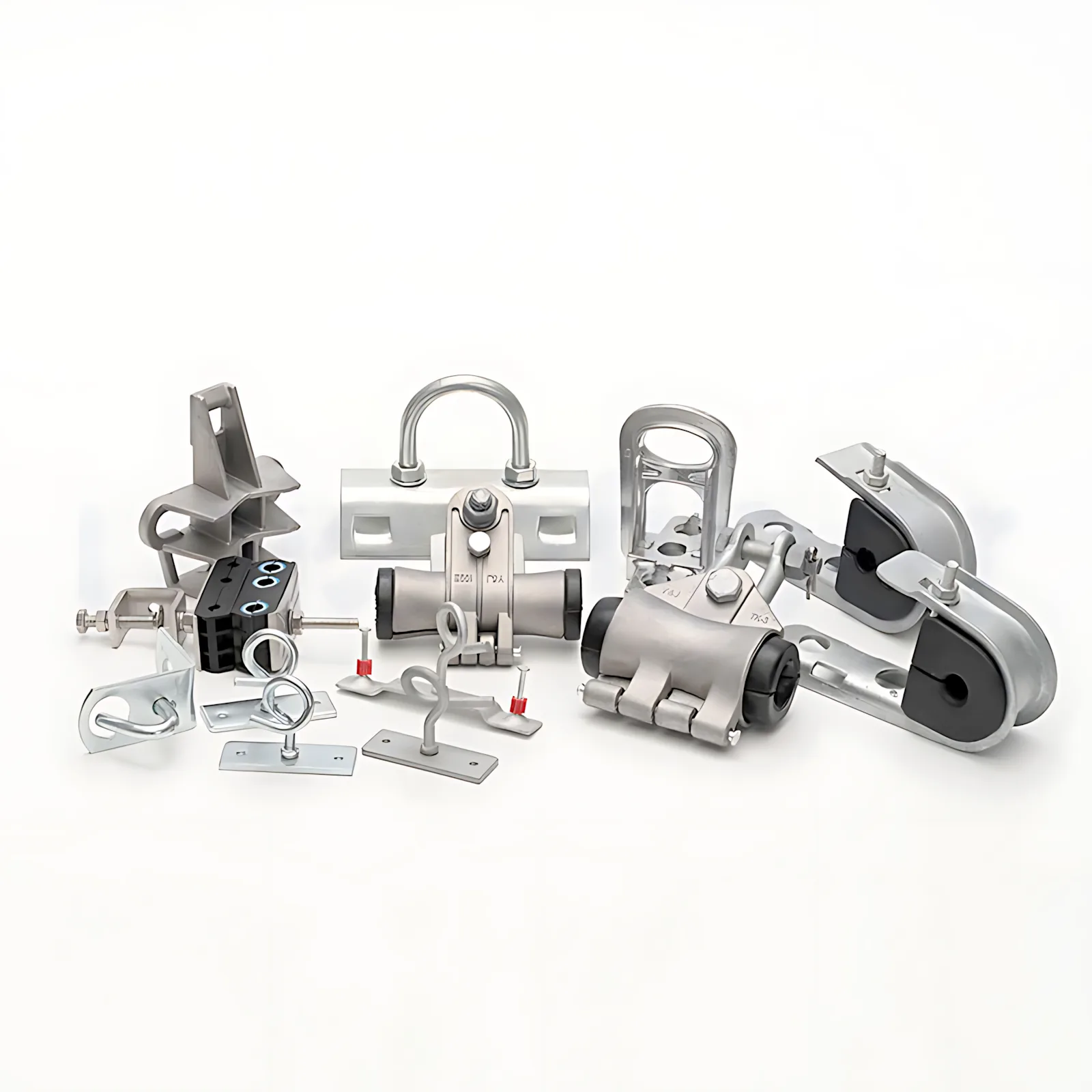
- Install hardware with hot sticks: Use insulated hot sticks (rated for the system voltage) to position and tighten suspension clamps, tensile dead-end clamps, and down-lead clamps from below the attachment zone.
- String the cable: Use a tensioned pay-out method with the reel positioned at ground level, well outside the MAD zone. Guide the cable upward using an insulated rope and snatch block. Never hand-carry the cable into the MAD zone.
- Tension and sag adjustment: Apply final tension using a come-along operated from below. Use a dynometer to verify tension matches the sag-tension chart for the ambient temperature at the time of installation.
Post-Installation
- Visual inspection: Verify all hardware components are properly seated, bolts are torqued, and no cable jacket damage is visible.
- OTDR baseline: Shoot an OTDR trace from each end before splicing. Record at 1310 nm and 1550 nm. Archive the trace as the acceptance baseline for future fault location.
- As-built documentation: Record actual sag, tension, attachment heights, and ambient conditions. Submit to the utility for their permanent records.
Expert Warning: Electrostatic Induction During Stringing
WARNING: While ADSS cable cannot conduct power-frequency current, it can accumulate electrostatic charge during stringing in high-voltage environments. As the cable is pulled through the electric field near energized conductors, capacitive coupling can build a surface potential of several kilovolts — enough to produce a startling (though non-lethal) discharge to ground.
Mitigation:
- Connect a temporary grounding brush or corona ring to the cable near the pay-out reel. The brush bleeds accumulated charge harmlessly to ground.
- Personnel handling the cable at ground level should wear insulating gloves rated for ≥1 kV during stringing operations near lines ≥110 kV.
- Keep the cable dry. A wet, polluted cable surface has significantly higher surface conductivity, increasing capacitive coupling efficiency.
Pre-Installation Checklist (Printable)
Copy and complete before every live-line ADSS installation:
☐ Line voltage confirmed and MAD documented
☐ Weather forecast clear (no rain, RH <85%)
☐ All crew briefed and JSA signed
☐ Insulated tools test-certified and inspected
☐ Hardware verified: correct suspension clamp set size and quantity per span schedule
☐ Cable drum serial number matches delivery note
☐ Sag-tension chart on-site for ambient temperature range
☐ Temporary grounding brush available (for ≥110 kV lines)
☐ OTDR and light source/power meter calibrated and on-site
☐ Emergency response plan communicated to all crew
FAQ
Q: Can ADSS be installed in rain?
A: No. Even though ADSS is dielectric, wet conditions reduce the insulating properties of air (the MAD is based on dry air). Rain also increases the risk of slip/fall on poles, degrades cable jacket traction in pulleys, and prevents reliable OTDR baseline testing.
Q: What is the safe distance for ADSS installation on a 220 kV line?
A: Per OSHA 1910.269, the MAD for 220 kV (phase-to-phase) is approximately 2.0–2.6 meters depending on the specific phase-to-ground voltage. Always confirm with the utility’s specific MAD table. Our engineering team can assist with voltage-specific attachment point recommendations.
Q: Do I need specialized tensioning equipment for live-line work?
A: Standard cable tensioning equipment (come-along, dynamometer) is suitable provided it is operated from ground level or a bucket truck outside the MAD zone. The cable itself requires no special handling beyond the electrostatic discharge precautions noted above.