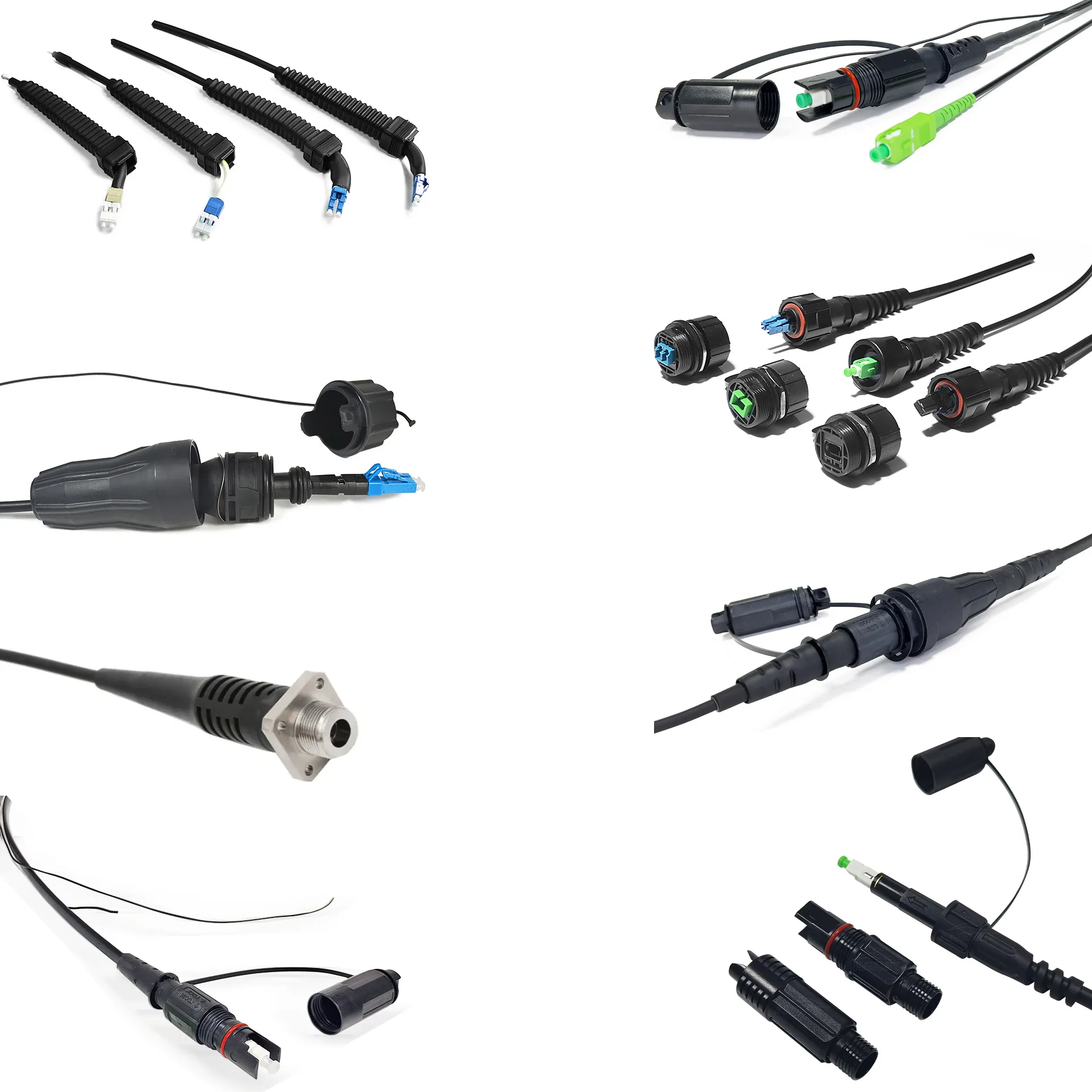
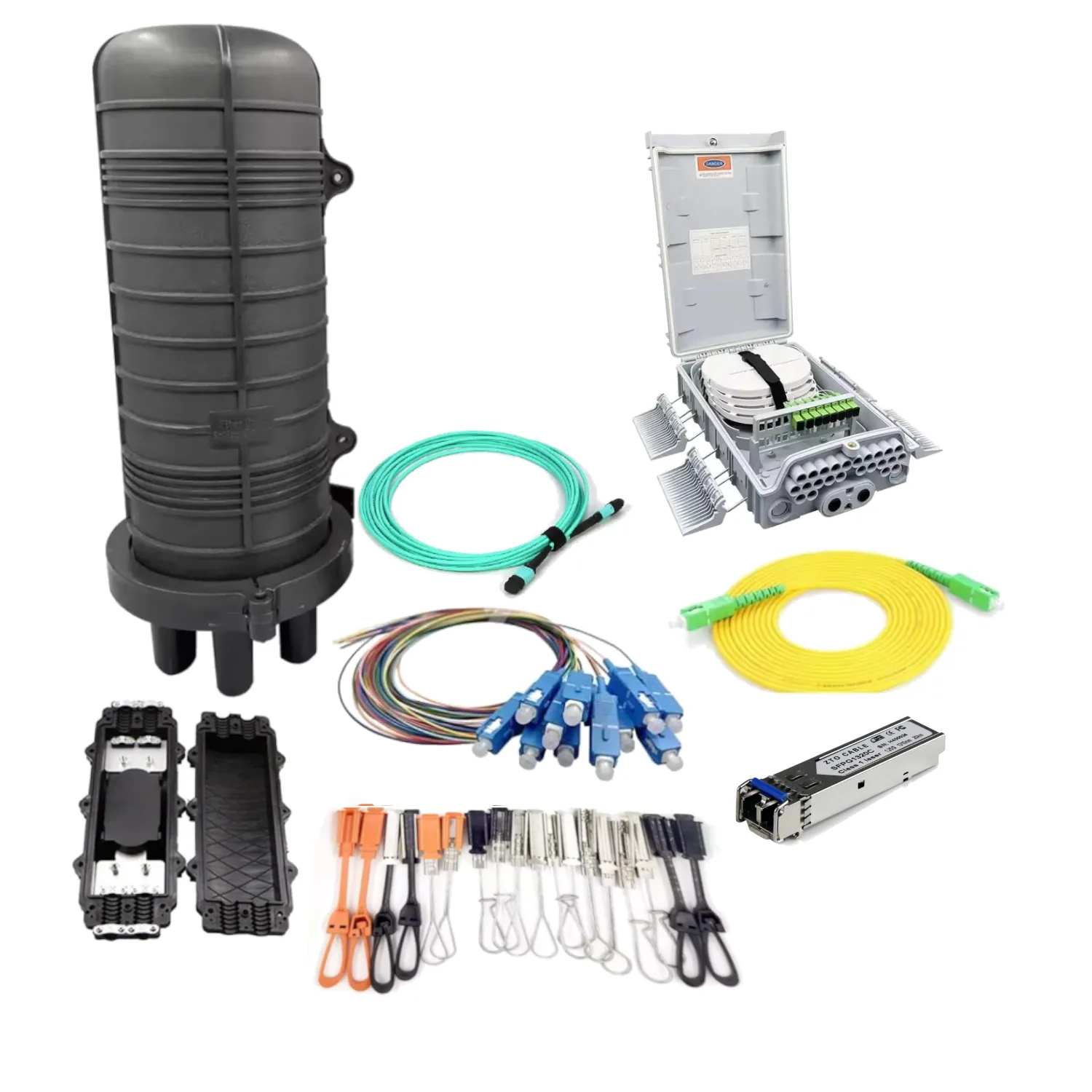
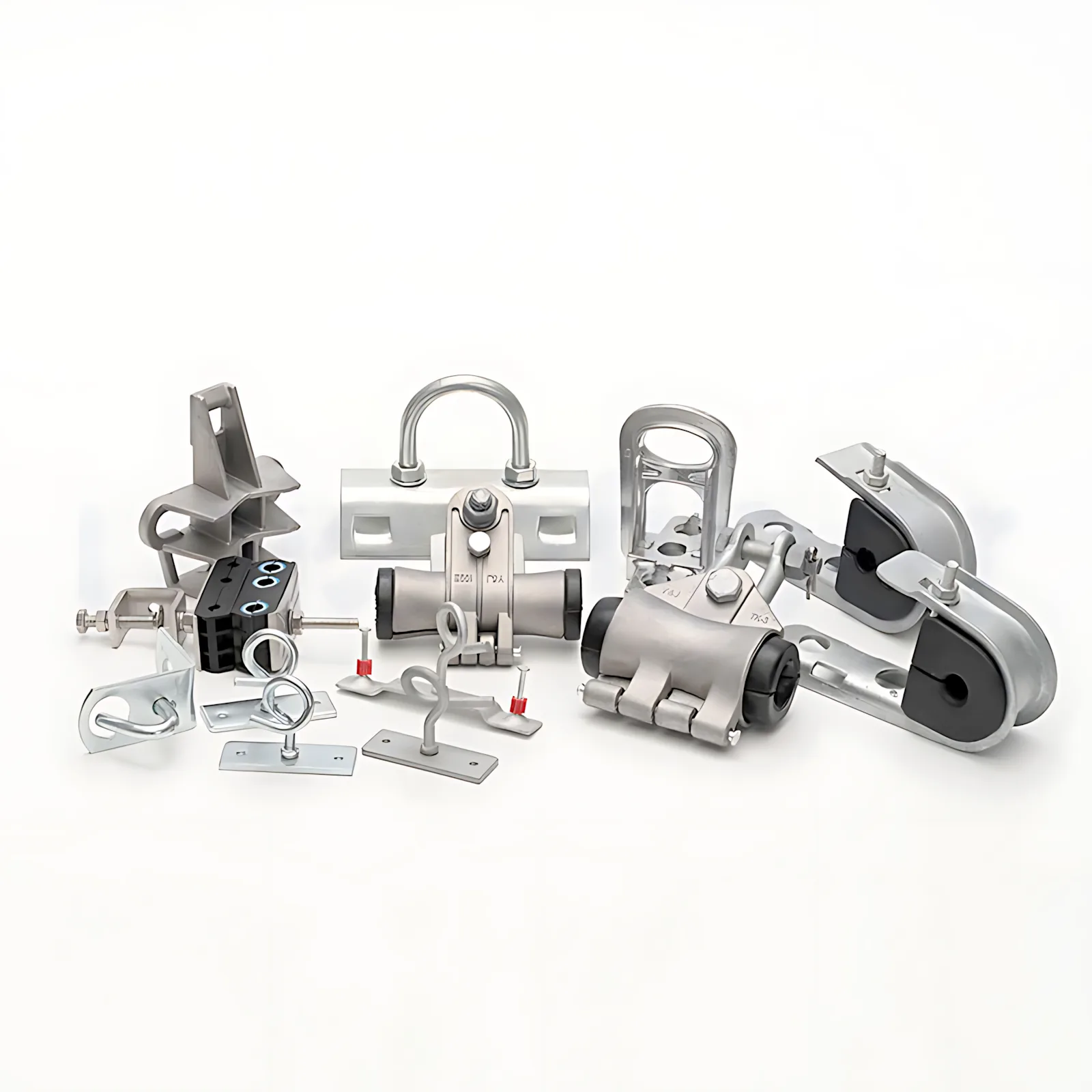
ADSS hardware selection is the difference between a 25-year network and premature failure:
Key Takeaway: The adage “three parts cable, seven parts hardware” holds in ADSS deployment — cable failure investigations consistently reveal that misapplied or mismatched hardware is the leading cause of premature failure, not cable defects. An ADSS cable designed for a 1000-meter span will fail within a year if installed with suspension clamps sized for a 300-meter cable. The preformed rods will slip under excessive tension, the jacket will abrade at the clamp edge, and the cable will eventually drop. This guide covers the four essential hardware categories — suspension clamps, tension (dead-end) clamps, vibration dampers, and down-lead clamps — with selection criteria, span-based sizing tables, and the compelling case for single-source cable-plus-hardware procurement.
The Four Essential ADSS Hardware Categories
1. Suspension Clamps (Tangent Supports)
Suspension clamp sets support the ADSS cable at intermediate (tangent) poles where the line direction does not change. The clamp must: cradle the cable without inducing concentrated bending stress, accommodate thermal expansion/contraction through a controlled slip mechanism, and protect the cable jacket from abrasion via an elastomeric insert or preformed armor rods.
The preformed rod style suspension clamp — widely used for ADSS — consists of helical rods that wrap around the cable, distributing the clamping force over a 400–800 mm length. This eliminates the point-loading problem inherent in bolted wedge clamps.
Sizing rule: The clamp grip length must be ≥4× the cable outer diameter for spans ≤500 m, and ≥6× for spans >500 m. The clamp’s rated vertical load (typically 5–30 kN) must exceed the supported cable weight by a factor of 2.5 for ice/wind conditions.
2. Tension (Dead-End) Clamps
Preformed rod tensile (dead-end) clamp sets anchor the cable at angle towers, terminal towers, and at both ends of every cable section. The clamp transfers the full cable tension into the tower structure via a clevis or thimble-eye connection to the tower attachment plate.
Critical selection parameter: The clamp’s rated tensile strength (RTS) must exceed the cable’s MAT by a minimum factor of 1.2, and ideally 1.5, to account for dynamic loads during ice shedding and wind gusts. For a cable with MAT = 55 kN, specify a dead-end clamp set with RTS ≥ 66 kN (preferably ≥ 82 kN).
A common error: using a dead-end clamp with preformed rods specified for OPGW (metallic surface) on ADSS (polymer jacket). The coefficient of friction between rod and jacket is materially different. Always specify ADSS-specific rod sets.
3. Vibration Dampers
Aeolian vibration — caused by vortex shedding as wind flows past the cylindrical cable — induces high-cycle fatigue at suspension points. The vibration frequency is governed by the Strouhal relationship: f = S × V / D, where S ≈ 0.185 (Strouhal number for cylinders), V is wind speed (m/s), and D is cable diameter (m). For a 16 mm cable in a 5 m/s wind, f ≈ 58 Hz — a frequency that over months of sustained wind can fatigue aramid yarn at the suspension clamp exit point.
Two damper types are commonly used:
- Spiral vibration dampers (anti-vibration whips): Helical plastic rods that wrap around the cable near suspension points. They dissipate energy through inter-strand friction and are effective across a broad frequency range (5–50 Hz). Best for spans ≤800 m.
- Stockbridge-type dampers: A messenger cable with two weights at each end, clamped to the cable. They are tuned to specific frequencies and are more effective for long spans (>800 m) where dominant Aeolian frequencies are lower.
Damper quantity and placement by span length:
| Span Length (m) | Dampers per Span Side | Type | Distance from Clamp (m) |
|---|---|---|---|
| ≤300 | 1 | Spiral | 0.5–1.0 |
| 300–600 | 1–2 | Spiral or Stockbridge | 0.8–1.5 |
| 600–1000 | 2 | Stockbridge | 1.0 + 1.8 |
| 1000–1500 | 3 | Stockbridge | 1.0 + 1.5 + 2.2 |
| >1500 | 3–4 | Stockbridge | Engineered per vibration study |
4. Down-Lead Clamps and Cable Guides
Down-lead clamps secure the ADSS cable as it transitions from the aerial attachment point down the tower/pole body to the splice closure at ground level. They prevent wind-induced cable slap against the tower steel, which would abrade the jacket over time. Spacing is typically 1.5–2.0 m vertically. At the tower base, J-hook suspension brackets guide the cable into underground duct entry.
Why Single-Source Procurement Matters
When ADSS cable is purchased from one supplier and hardware from another, three problems routinely arise:
- Mismatched clamp bore diameter: The hardware supplier’s clamp may be specced for a cable diameter ±1 mm different from the actual cable. At the clamp edge, this creates a stress concentration that initiates jacket cracking.
- Incompatible rod grip characteristics: Preformed rods are designed for a specific cable jacket material and surface hardness. Generic rods may grip too tightly (crushing the loose tube) or too loosely (slipping under tension).
- Warranty fragmentation: When a failure occurs, the cable supplier blames the hardware, the hardware supplier blames the cable, and the project owner is left with an unresolved claim.
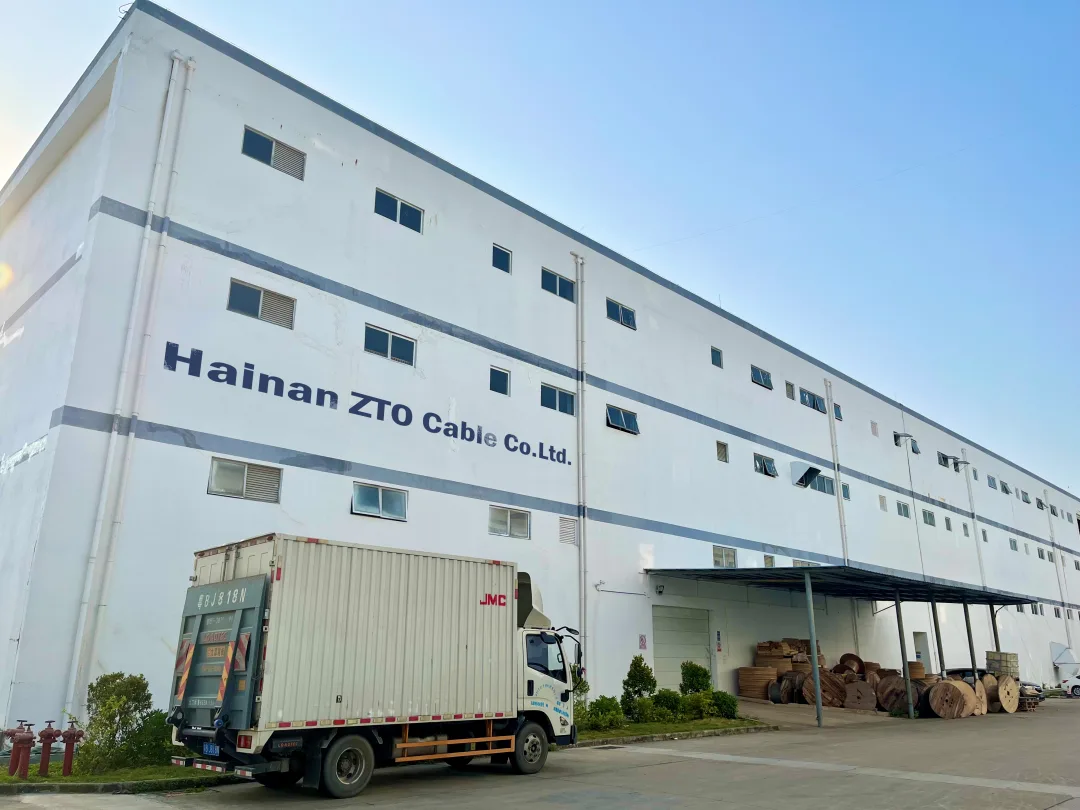
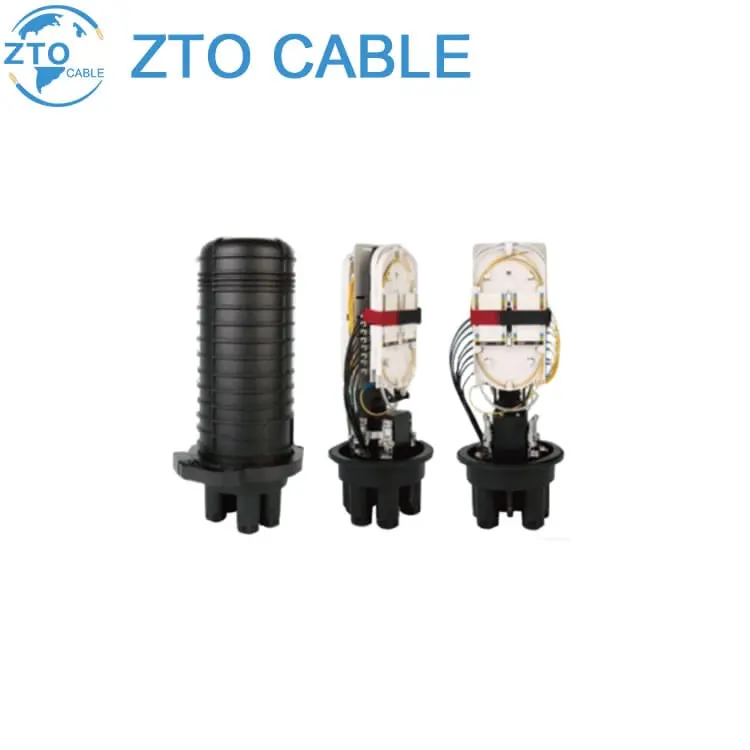
ZTO Cable provides complete ADSS cable + hardware packages — the cable, suspension clamps, tension clamps, vibration dampers, down-lead clamps, joint closures, and J-hooks are all designed, matched, and tested as a system. One warranty, one point of contact, zero finger-pointing.
FAQ
Q: What size tension clamp do I need for an ADSS cable on a 1200 m span?
A: First, confirm the cable’s MAT from the manufacturer’s datasheet (typically 55–80 kN for 1200 m spans). Select a tension clamp set with RTS ≥ 1.5 × MAT. For example, MAT = 60 kN → specify clamp with RTS ≥ 90 kN. Also verify the clamp’s rod length is ≥8× the cable diameter for spans >1000 m.
Q: How many spiral vibration dampers are needed for a 500 m span?
A: Two spiral dampers per span — one on each side of the suspension clamp, positioned 0.8–1.2 m from the clamp exit. In exposed terrain (open plains, coastal ridges), add a second pair at 1.8 m spacing. Our hardware engineering team can provide span-specific damper placement diagrams based on your route survey data.
Q: Can I use the same suspension clamp for ADSS and OPGW?
A: No. ADSS clamps use an elastomeric or preformed rod grip designed for a polymer jacket with a specific coefficient of friction and compressibility. OPGW clamps are designed for metallic surfaces and may include armor rod provisions for aluminum-clad steel. Using an OPGW clamp on ADSS will either slip (insufficient grip) or damage the jacket (excessive localized pressure). Always source ADSS-specific suspension hardware.