


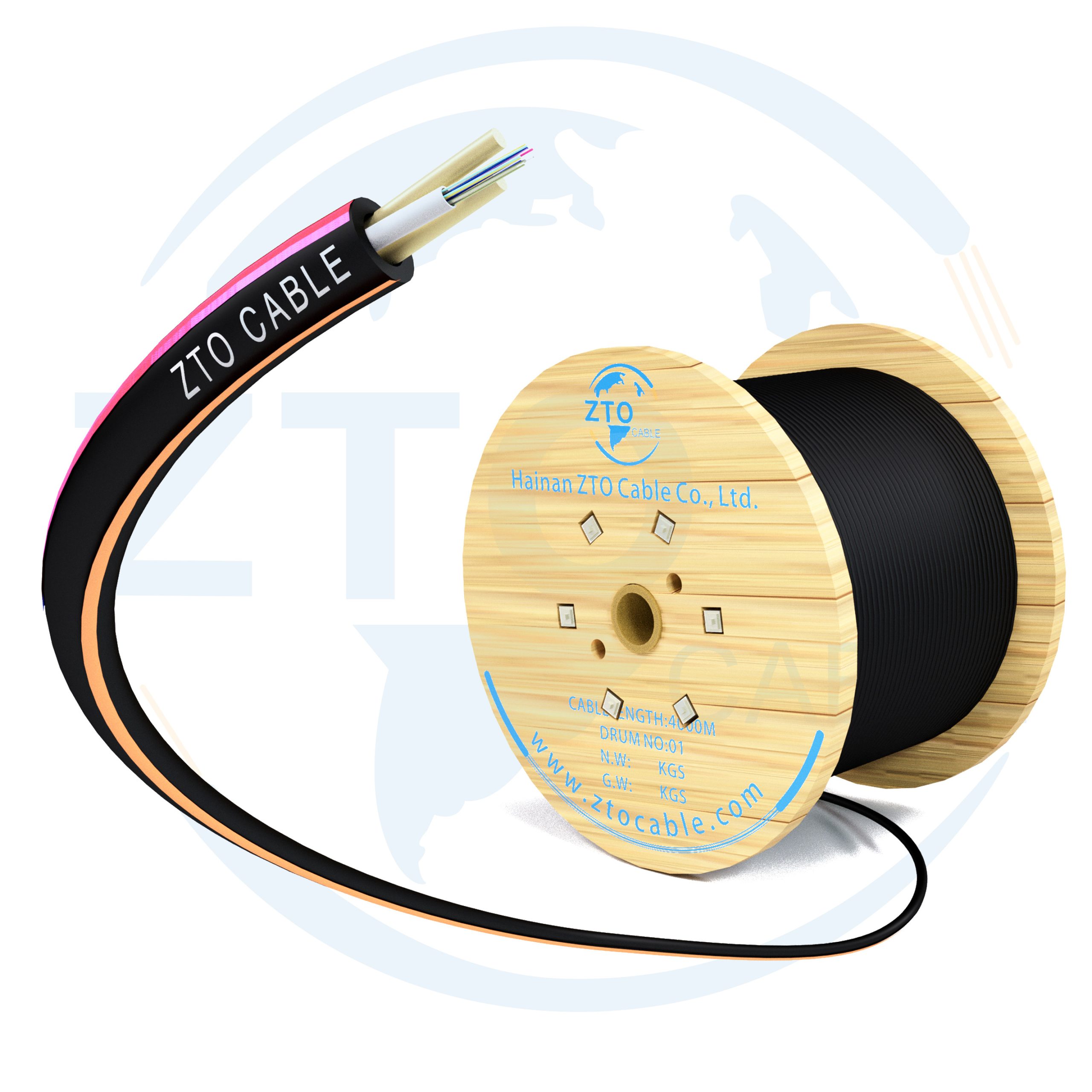
Description
The ASU fiber optic cable is a type of optical fiber cable designed for outdoor aerial installations. ASU stands for “All-Dielectric Self-Supporting,” indicating that it is a non-metallic cable and does not require additional support elements like steel messenger wires for aerial installations. The fiber optic cable structure is put the ф250μm colored fiber in the PBT loose tube, and two FRP as strengthen member, Cable surface is extruded with a PE outer sheath. It also belongs to overhead fiber optical cable.
Structure

Characteristics
Standard
YD/T 901-2018、GB/T13993 、IECA-596、GR-409、IEC794 and so on standard
Application
ASU cable is being designed For overhead installation, PE outer sheath is applied. The dedicate design of FRP strength member quantity can satisfy the demand on various spans, such as 50M, 80M, 100M, 120M.
For specific data sheet, please write to [email protected], whatsapp+86 15802524130 Or click here!
FAQ
ASU is a smaller, lighter version of ADSS for short-span applications. Standard ADSS uses aramid yarn as the strength member and supports 50–1500 m spans depending on configuration. ASU uses two embedded FRP (Fiber Reinforced Plastic) rods as strength members, supporting spans of 50–120 m. The smaller diameter (typically 6–8 mm) and lighter weight (typically 60–100 kg/km) make ASU significantly easier to install for short aerial spans — especially for FTTH drop, last-mile access networks, and rural broadband where the typical span is under 120 m. The all-dielectric design means no grounding is required, even in proximity to power lines.
ASU cable supports 50 m, 80 m, 100 m, and 120 m self-supporting spans as standard configurations. The exact span capability depends on the FRP strength member diameter (1.0–1.6 mm typical) and cable design. The ‘span’ in the product name indicates the maximum self-supporting distance between two support poles under NESC light loading conditions. For NESC medium or heavy loading areas (high wind, ice), the maximum span is typically reduced by 20–30%. For longer spans (150 m+), ZTO recommends upgrading to standard ADSS cable with aramid yarn strength members.
Yes. Although ASU is designed primarily for short-span aerial installation, it is also suitable for duct installation due to its small diameter and PE jacket. Duct fill ratio should be 50–70% for proper cable pulling. The 6–8 mm diameter allows ASU to fit in standard 1-inch (25 mm) or larger ducts. For duct installations longer than 500 m, intermediate pull boxes are recommended. ASU is not designed for direct burial — for buried applications, ZTO recommends GYTA (armored duct) or GYTS (stranded armored) cable instead.
Standard ASU configurations support 2, 4, 6, 8, 12, and 24 fibers using G.652D single-mode fiber. For 12–24 core configurations, the cable diameter increases to 7–8 mm. Higher fiber counts (48+) are not typical for ASU due to the two-FRP strength member design — for higher counts, stranded loose tube ADSS or standard ADSS with aramid yarn is recommended. Most FTTH drop and last-mile applications use 2-core or 4-core ASU configurations, with one fiber for primary service and one spare for redundancy or future upgrade.
ASU cable is manufactured to comply with YD/T 901-2018 (China telecom industry standard for outdoor fiber optic cables), GB/T 13993 (China national standard for telecommunication cables), IECA-596 (industry standard for self-supporting drop cables), GR-409 (Telcordia generic requirements for indoor-outdoor cables), and IEC 794 (IEC standard for optical fiber cables). Each reel ships with full OTDR test reports at 1310 nm and 1550 nm, plus a Certificate of Conformance. Custom certification for specific country telecom authority requirements (e.g., CE for EU, FCC for US) can be arranged on request.


