


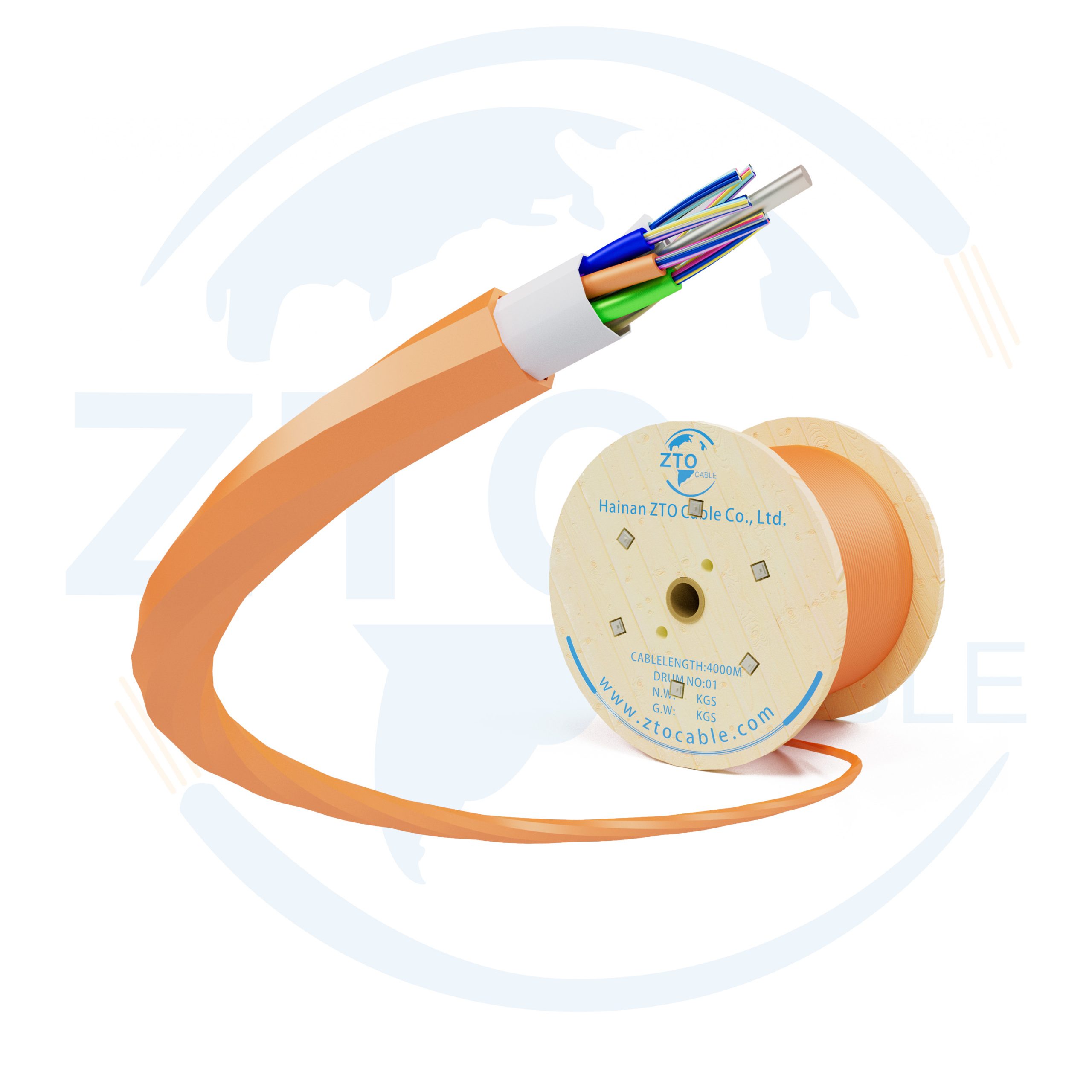
Stranded Loose Tube Micro Air Blown Fiber Optic Cable GYFY
- Satisfaction guarantee
- Fast delivery
- Quality assurance
Description
The Stranded Loose Tube Micro Air Blown Fiber Optic Cable GYFY is a specialized type of fiber optic cable designed for micro air-blown fiber installation systems. It features a stranded loose tube design, making it suitable for outdoor and indoor applications where flexibility and ease of installation are essential. Large core number air blowing cable GYFY cable structure is the phi 250 mu m optical fibers are jacketed high modulus material made of loose tube, the loose casing pipe is filled with waterproof compound, loose tube around the center of the strengthen core twist synthetic compact round cable core, the cable core gap mid to moisture-proof waterproof yarn, then extruding PE sheathed cable.
Structure

Characteristics
Application
Using microtubule resources, especially for the backbone network, access network and fiber to the home.
Cabling costs are low and suitable for upgrading the old city and building network.
Standard
YD / T769-2010, GB / T 9771-2008, IEC794 and other standards
In addition to ordinary PE products, if LSZH products choose different materials, can meet IEC 60332-1 or IEC 60332-3C certification
For specific data sheet, please write to [email protected], whatsapp+86 15802524130 Or click here!
FAQ
Air-blown cable (jetting) uses compressed air to push the cable through pre-installed micro-ducts at speeds up to 50–100 m/min, while traditional pulled cable relies on mechanical force and is limited to 30–60 m per pull. Air-blown installation reduces labor cost by 50–70% in long-distance or multi-duct networks, allows staged fiber deployment (blow more fibers later as subscriber demand grows), and minimizes cable mechanical stress — extending cable service life. It is the preferred method for backbone, access, and FTTH networks using micro-duct infrastructure.
Standard GYFY configuration supports up to 144 fibers (stranded loose tube design with 12 fibers per tube). Maximum single-blow distance depends on duct route: typically 1,000–2,000 m for straight routes with minimal bends, 500–1,000 m for typical urban access networks with multiple 90° bends, and 200–500 m for routes with multiple 180° bends. Blowing equipment pressure and cable-lubricant pre-treatment affect achievable distance. ZTO engineering team can advise on duct-route-specific blowing distance estimates.
Standard GYFY cable is designed for installation in 10/12 mm or 12/14 mm micro-ducts (10–12 mm inner diameter). Duct fill ratio should be 50–70% for optimal blowing performance — ZTO provides duct-size recommendations based on your cable outer diameter. Pre-installed micro-duct bundles (typically 1–7 ducts per bundle) are commonly deployed during road construction or building infrastructure projects, then GYFY is blown in later as subscriber demand materializes.
In brownfield projects with existing occupied ducts, GYFY is not directly applicable because the ducts are already full. However, for greenfield installations or projects with new micro-duct infrastructure, GYFY air-blown cable is the cost-effective choice. For brownfield upgrades, ZTO recommends slim duct-overduct solutions: install new micro-ducts inside the existing duct, then blow GYFY cables — this is a common technique for city network upgrades where trenching is too expensive.
Standard GYFY uses PE jacket. For indoor riser or plenum applications where fire safety is required, LSZH (Low Smoke Zero Halogen) versions are available meeting IEC 60332-1 (single cable vertical flame test) or IEC 60332-3C (bunched cable vertical flame test). Compliance with YD/T 769-2010, GB/T 9771-2008, and IEC 794 optical/mechanical specifications is standard across all configurations. Indicate your project’s fire-rating requirements at the time of quote to receive the appropriate jacket material recommendation.
Extended Micro Air Blown Range: 144–864 Cores
The Stranded Loose Tube Micro Air Blown Fiber Optic Cable GYFY supports a full core count range from 144 cores up to 864 cores for high-density microduct air-blown installation systems. Standard stock ships in 144 / 216 / 288 cores; large-count configurations (432 / 576 / 864 cores) are manufactured on order. The stranded loose tube design with HDPE outer jacket provides excellent air-blown installation performance in microduct inner diameters of 14 mm to 28 mm.
GYFY Extended Core Count Specifications (144-864 cores)
| Parameter | Value |
|---|---|
| Fiber count | 144 / 216 / 288 / 432 / 576 / 864 cores |
| Cable outer diameter (144 cores) | ≈ 8.5 mm |
| Cable outer diameter (216 cores) | ≈ 9.5 mm |
| Cable outer diameter (288 cores) | ≈ 10.5 mm |
| Cable outer diameter (432 cores) | ≈ 12.0 mm |
| Cable outer diameter (576 cores) | ≈ 13.5 mm |
| Cable outer diameter (864 cores) | ≈ 15.5 mm |
| Cable weight (144 cores) | ≈ 65 kg/km |
| Cable weight (216 cores) | ≈ 80 kg/km |
| Cable weight (288 cores) | ≈ 95 kg/km |
| Cable weight (432 cores) | ≈ 125 kg/km |
| Cable weight (576 cores) | ≈ 160 kg/km |
| Cable weight (864 cores) | ≈ 220 kg/km |
| Recommended microduct inner diameter | 14 mm (144-216C); 16 mm (288-432C); 20 mm (576C); 25 mm (864C) |
| Maximum air-blowing distance | Up to 2000 m per blow |
| Maximum air-blowing pressure | 15 bar |
| Minimum bend radius | 20 × cable diameter |
| Operating temperature | -40 °C to +70 °C |
Typical large-count GYFY applications: FTTH feeder from central office to MDU/MTU riser backbone, metro ring backbone between POP sites, hyperscale data center entrance fiber (144-432 cores), 5G fronthaul backbone (288-864 cores), and inter-building campus backbone in university and enterprise networks.


