


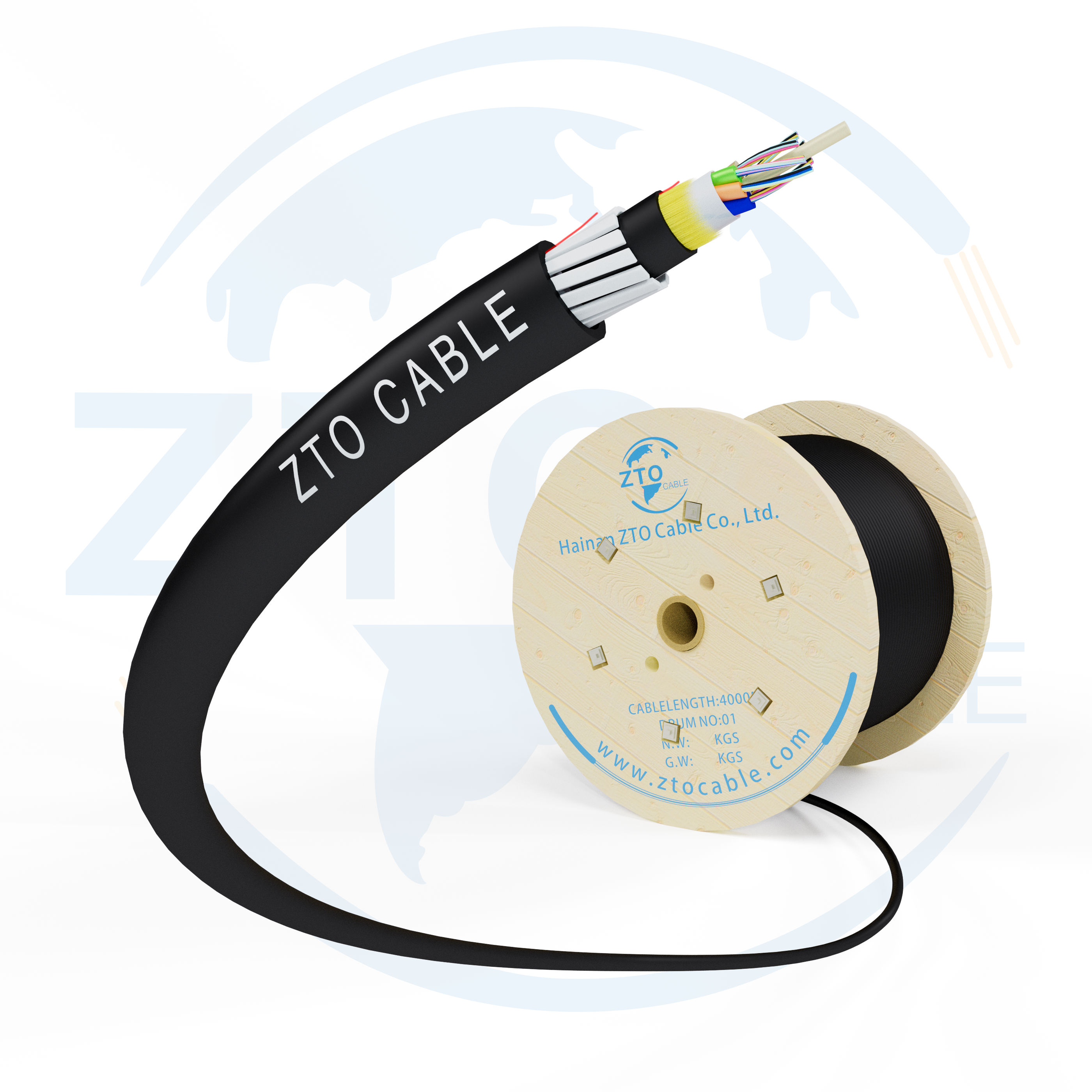
Anti-Rodent FRP Armored Double Jacket ADSS Aerial Cable
All-dielectric ADSS cable with FRP armor, double-jacket construction, and anti-rodent outer sheath for maximum protection in hostile deployment zones. 2-144 cores, 200-1000M spans, crush resistance ≥4000 N/100mm. Ideal for agricultural, forested, and wildlife-prone aerial installations.
- Satisfaction guarantee
- Fast delivery
- Quality assurance
Description
Product Overview
The Anti-Rodent FRP Armored Double Jacket ADSS Aerial Cable combines fiber-reinforced plastic (FRP) armor with double-jacket construction and anti-rodent protection — delivering the ultimate defense against mechanical damage, wildlife, and environmental stress in hostile deployment zones. This is ZTO’s most robust ADSS offering for installations where standard dielectric cables face unacceptably high failure risk from rodent activity.
Three layers of protection work together: an inner HDPE jacket, a helical FRP armor layer for physical bite resistance, and an anti-rodent outer HDPE jacket with embedded deterrent additives. The result is a cable that maintains all-dielectric properties while providing crush resistance exceeding 4000 N/100mm — comparable to metallic armored cables without the grounding and lightning risks.
Key Technical Specifications
| Parameter | Specification |
|---|---|
| Fiber Count | 2–144 cores (G.652D standard) |
| Span Range | 200M to 1000M |
| Cable Construction | Inner HDPE jacket + FRP armor layer + anti-rodent outer HDPE jacket |
| FRP Armor | 1.6mm–2.5mm FRP rods in helical lay (non-metallic, non-conductive) |
| Crush Resistance | ≥4000 N/100mm (long-term) |
| Impact Resistance | ≥10 J (per IEC 60794-1 E4) |
| Anti-Rodent Protection | Outer jacket with embedded deterrent + FRP physical barrier |
| Attenuation | ≤0.36 dB/km @1310nm, ≤0.22 dB/km @1550nm |
| Temperature Range | -40°C to +70°C |
| Compliance | IEC 60794-4-20, ITU-T G.652, GB/T 2918 (rodent test) |
Applications
- Agricultural Regions: Farmland and rural deployments where rodent populations are high and cable damage from gnawing is a persistent problem.
- Forested & Tropical Areas: Wildlife-rich environments where squirrels, rats, and other rodents pose a constant threat to aerial infrastructure.
- High-Risk Power Line Corridors: Transmission and distribution line co-location in areas with documented rodent damage history.
- Long-Span Wilderness Crossings: Remote aerial spans (200–1000M) where cable replacement is logistically difficult and costly — maximum reliability is essential.
FRP vs. Steel Tape Armor: Why FRP Wins
| Feature | FRP Armor (ZTO) | Steel Tape Armor |
|---|---|---|
| Dielectric (Non-Conductive) | Yes — safe near power lines | No — requires grounding |
| Lightning Risk | Minimal | High — acts as conductor |
| Weight | Lightweight | Heavy — adds significant load |
| Corrosion | Immune | Prone to rust in humid climates |
| Crush Resistance | ≥4000 N/100mm | ≥3000 N/100mm |
| Rodent Bite Resistance | GB/T 2918 tested | GB/T 2918 tested |
Ordering Information
MOQ: 10KM per order
Lead Time: 20–30 days
Custom Options: Fiber type, FRP rod diameter, jacket color, anti-rodent deterrent formulation, and packaging available on request.
FAQ
FRP (Fiber Reinforced Plastic) rods are spirally wound between the inner and outer HDPE jackets, creating a physical barrier that rodent teeth cannot penetrate. Combined with the chemical deterrent in the outer jacket, this provides dual-layer protection.
FRP armor maintains the all-dielectric property of ADSS — no metal means no grounding required on power lines up to 110kV. Steel tape armor would require bonding and grounding, adding cost and complexity.
200M to 1000M, making it suitable for medium to long-span installations in environments with severe rodent activity.


