


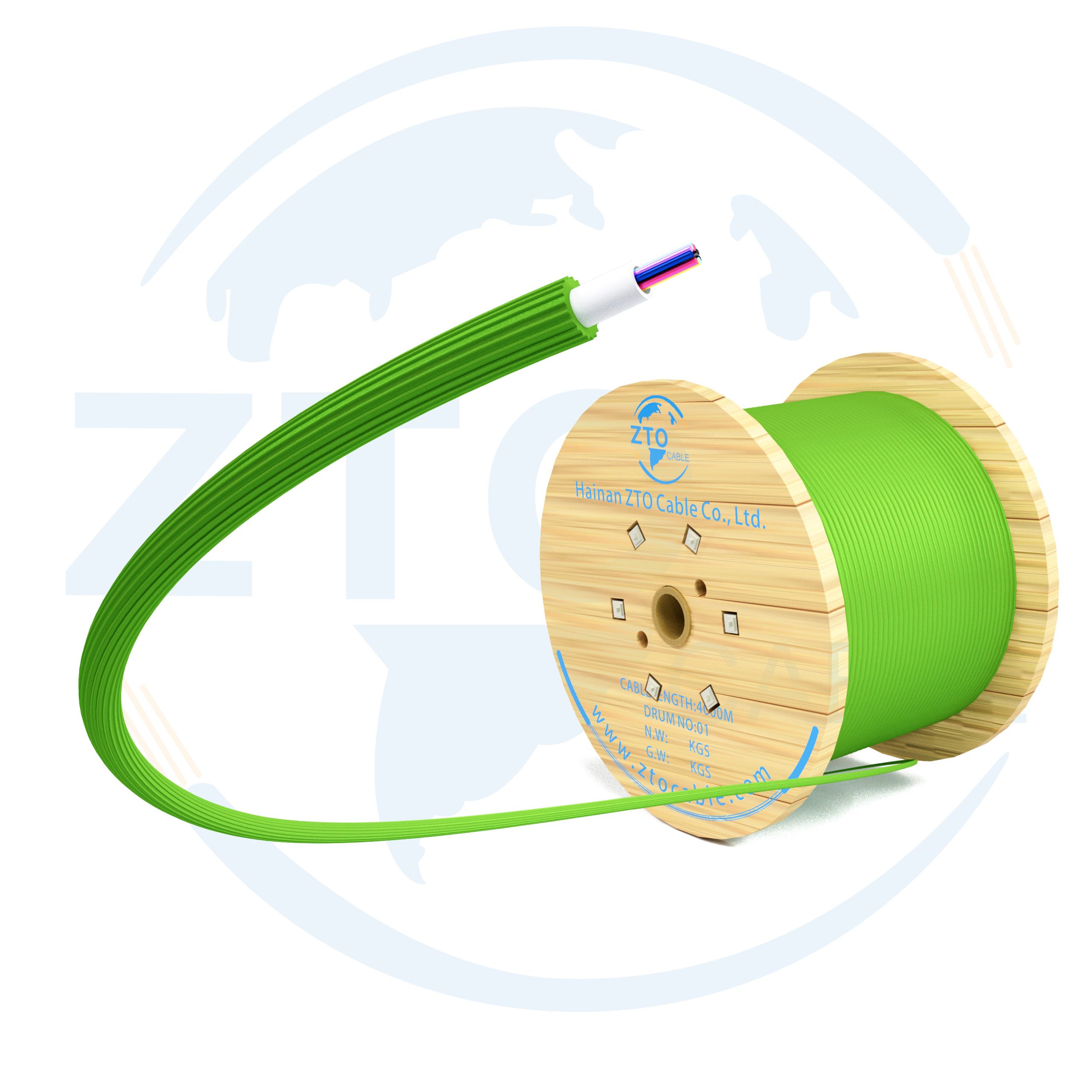
EPFU Micro Air Blown Fiber Optic Cable Fiber Unit
- Satisfaction guarantee
- Fast delivery
- Quality assurance
Description
The EPFU Micro Air Blown Fiber Optic Cable Fiber Unit is a specific type of fiber optic cable designed for microfiber air-blown installation systems. This cable is used as the fiber unit within the air-blown installation process, which involves blowing or pushing microfiber cables through pre-installed ducts or pathways using compressed air. Enhanced Performance Fibre Units (EPFU) Optical fibers and filler elements are arranged in curing photosensitive resins to form a cable core. A low friction sheath is extruded outside the core. The EPFU fiber units contains microfiber optical fibers, which are thinner and more lightweight than standard optical fibers. Microfiber cables are specifically designed for air-blown installation systems due to their reduced air resistance and ease of deployment.
Structure

Characteristics
Standard
YD / T769-2010, GB / T 9771-2008, IEC794 and other standards
In addition to ordinary PE products, if LSZH products choose different materials, can meet IEC 60332-1 or IEC 60332-3C certification
For specific data sheet, please write to [email protected], whatsapp+86 15802524130 Or click here!
FAQ
EPFU (Enhanced Performance Fibre Unit) is a single-unit product containing typically 2–12 fibers, while standard air-blown cables (like GYFY or center tube) are complete multi-fiber cables. EPFU is designed for staged deployment: install a multi-duct bundle (e.g., 5–7 micro-ducts) once, then blow additional EPFUs as subscriber demand grows — paying only for the capacity you need, when you need it. Each EPFU costs less upfront than a full multi-core cable, and the staged investment model is particularly attractive for FTTH greenfield deployments where take-up rates are uncertain.
Standard micro-duct bundles contain 1, 2, 4, 5, 7, or 12 ducts per bundle, with each duct having 10/12 mm or 12/14 mm inner diameter. After initial installation of one EPFU in each primary duct, additional EPFUs can typically be blown into already-occupied ducts (sequential blowing) up to 4–6 EPFUs per duct before duct fill ratio becomes a limiting factor. The exact number depends on EPFU outer diameter (typically 1.5–3.0 mm) and duct inner diameter. ZTO can advise on the optimal duct count and EPFU diameter for your subscriber density forecast.
Standard EPFU configurations support 2, 4, 6, 8, and 12 fibers per unit using G.657A2 bend-insensitive fiber. For higher per-unit capacity, 24-core EPFUs are available on special request. Most FTTH deployments use 2-core or 4-core EPFUs (one for primary service, one spare for redundancy or future upgrade). The G.657A2 fiber with 7.5mm minimum bend radius allows EPFU to be routed through tight indoor corners during final drop installation, eliminating the need for a separate indoor cable.
Single-blow distances of 1,000–2,000 m are typical for straight duct routes. For access network routes with multiple bends, expect 500–1,200 m per blow. The low-friction sheath design reduces air resistance and extends blowing distance by 20–40% compared to standard jacket designs. Blowing equipment operates at 8–12 bar pressure, and the small EPFU diameter (1.5–3.0 mm) requires lower air volume per meter of cable, which translates to faster installation speed and lower energy cost for large-scale deployments.
Yes. EPFU with G.657A2 fiber and LSZH jacket is fully compliant for indoor FTTH drop applications. The ultra-thin profile (1.5–3.0 mm diameter) fits standard indoor conduit, surface-mount raceways, and even direct-bend routing around door frames. Compliance with YD/T 769-2010, GB/T 9771-2008, IEC 794, and fire safety standards (IEC 60332-1 or IEC 60332-3C for LSZH versions) makes EPFU suitable for routing from the building entry point through risers and corridors directly to the subscriber’s ONT. Many European FTTH operators prefer EPFU over traditional indoor drop cables for its compact size and installation flexibility.
EPFU Series: 12–432 Cores Fiber Unit
The EPFU (Enhanced Performance Fiber Unit) is a single fiber unit that stacks inside a HDPE outer sheath to build micro air-blown cable assemblies from 12 cores up to 864 cores total capacity. Each EPFU is a self-contained 2.0–3.5 mm diameter fiber unit with its own HDPE jacket, water-blocking, and ripcord. Stacking 2–24 EPFUs inside an outer jacket creates the full assembly. EPFU is the modular building block for high-density micro air-blown deployments.
EPFU Fiber Unit Specifications
| Parameter | Value |
|---|---|
| EPFU cores | 12 / 24 / 48 / 72 / 96 / 144 / 216 / 432 cores per unit |
| EPFU outer diameter (12 cores) | ≈ 2.0 mm |
| EPFU outer diameter (24 cores) | ≈ 2.4 mm |
| EPFU outer diameter (48 cores) | ≈ 2.8 mm |
| EPFU outer diameter (72 cores) | ≈ 3.0 mm |
| EPFU outer diameter (96 cores) | ≈ 3.2 mm |
| EPFU outer diameter (144 cores) | ≈ 3.5 mm |
| EPFU outer diameter (216 cores) | ≈ 4.0 mm |
| EPFU outer diameter (432 cores) | ≈ 5.0 mm |
| EPFU jacket material | HDPE |
| EPFU color | Natural / White (per TIA-598-D) |
| Stacking capacity (typical outer sheath) | Up to 24 EPFUs in 28 mm outer sheath = 864 cores total |
| Bend radius (EPFU) | 15 × EPFU diameter |
| Maximum air-blowing distance | Up to 2000 m per blow |
EPFU + Outer Sheath Combinations (full assembly examples):
- 2 × EPFU-144 = 288 cores in 16 mm outer sheath (recommend 18 mm microduct)
- 3 × EPFU-144 = 432 cores in 18 mm outer sheath (recommend 20 mm microduct)
- 4 × EPFU-144 = 576 cores in 20 mm outer sheath (recommend 22 mm microduct)
- 6 × EPFU-144 = 864 cores in 24 mm outer sheath (recommend 28 mm microduct)
- 2 × EPFU-216 = 432 cores in 17 mm outer sheath
- 4 × EPFU-216 = 864 cores in 22 mm outer sheath
EPFU vs GYFY (id=3139) vs Center Tube (id=3137): EPFU gives the highest density per outer diameter because each EPFU is independently blown and stackable. GYFY stranded is the most common for duct and backbone; center tube gives smallest diameter for tight microducts.


