


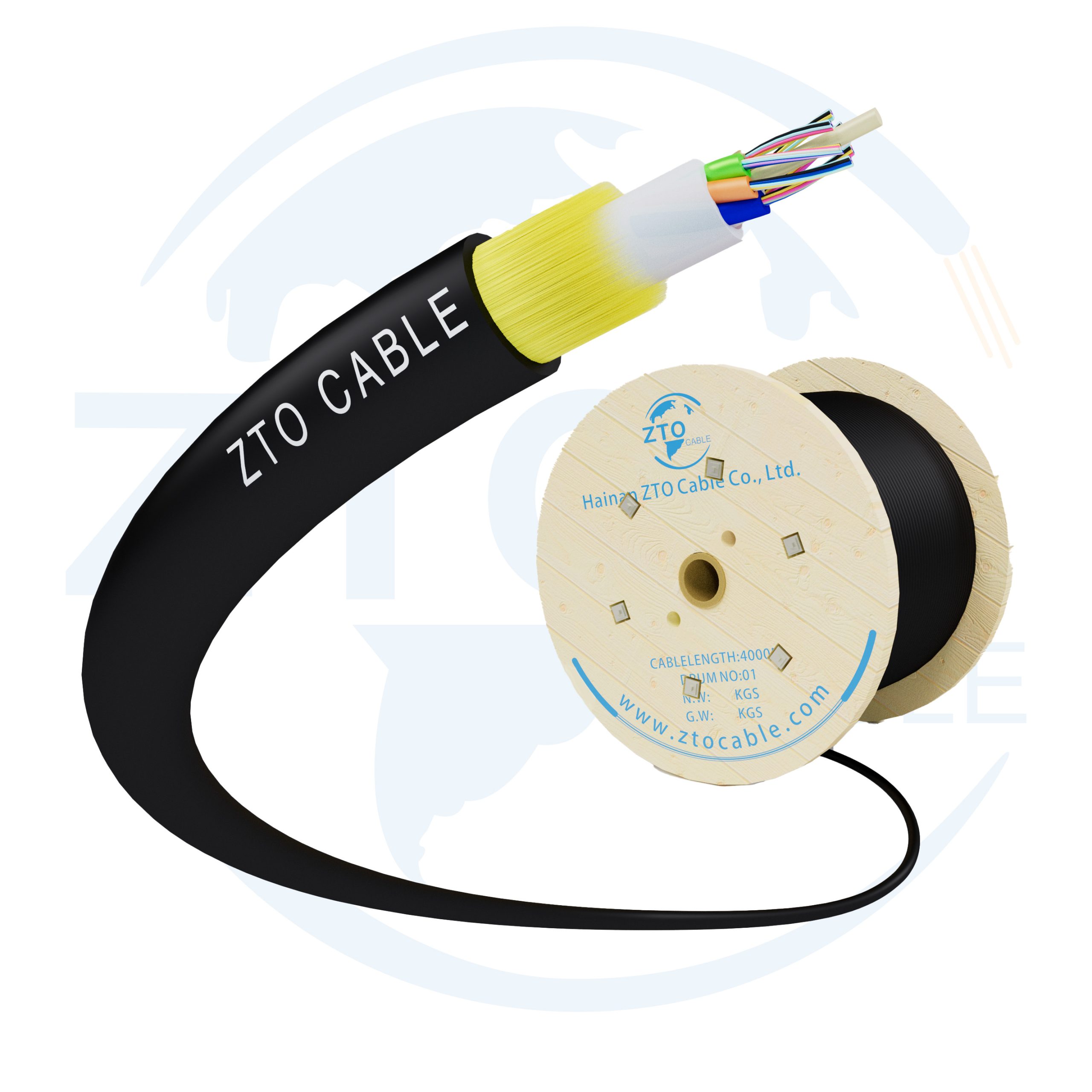
Center Tube Micro Air blown Fiber Optic cable
- Satisfaction guarantee
- Fast delivery
- Quality assurance
Description
The Center Tube Micro Air Blown Fiber Optic Cable is a specialized type of fiber optic cable designed for air-blown fiber installation systems. It features a central tube construction and is specifically engineered for microfiber cables. This type of cable is commonly used in indoor and outdoor applications, where flexibility and ease of installation are essential. Optical fibres are housed in a loose tube that is made of high-modulus plastic and filled with tube filling compound. Aramid yarns are placed outside the loose tube as the strength member, then a sheath with grooves is extruded. This type of cable is particularly applicable to air-blowing constructions in access networks.Its number of cores includes: 12 24 36 48 96 144 192 288 cores, etc.
Structure

Characteristics
Standard
YD / T769-2010, GB / T 9771-2008, IEC794 and other standards
In addition to ordinary PE products, if LSZH products choose different materials, can meet IEC 60332-1 or IEC 60332-3C certification
For specific data sheet, please write to [email protected], whatsapp+86 15802524130 Or click here!
FAQ
Center tube (CT) design has all fibers in a single central tube — it is more compact, has higher fiber density per cable cross-section, and offers greater blowing distance due to its symmetrical, low-friction profile. Stranded loose tube (SZ) design has multiple smaller tubes stranded around a central strength member — it scales to higher fiber counts (288+ cores) more economically. ZTO center tube cables are typically used for access network and FTTH up to 144 cores, while stranded designs are preferred for backbone applications requiring 288–576 cores.
Center tube design supports 12, 24, 36, 48, 96, 144, 192, and 288 cores. For 12–144 cores the cable diameter is in the 5.5–8.5 mm range (fits 10/12 or 12/14 mm micro-ducts). For 192–288 cores, diameter increases to 9–11 mm and may require 14/16 mm micro-ducts. For projects requiring more than 288 cores, ZTO recommends switching to stranded loose tube design for better cost-efficiency and duct fill ratio.
The grooved sheath (also called ribbed or profiled sheath) reduces surface friction between the cable and the micro-duct inner wall during air-blown installation. This extends maximum blowing distance by 30–50% compared to smooth-sheath designs at the same air pressure. The grooves also distribute air pressure more evenly around the cable circumference, improving blowing stability over multi-bend routes. The trade-off is slightly higher cost and a marginally larger outer diameter, but for access networks with long or curved duct runs the performance gain is significant.
Standard options include G.652D (standard single-mode, lowest cost), G.657A1 (bend-insensitive, 15mm bend radius), G.657A2 (extra bend-insensitive, 7.5mm bend radius, ideal for indoor transitions), and multimode OM3/OM4 for short-reach data center and enterprise applications. For FTTH access networks, G.657A2 is most common because it allows tight bends during indoor drop installation. For long-haul or high-speed applications, G.652D is standard. The fiber type can be mixed within a single cable on request.
In optimal conditions (straight duct, low friction), single-blow distances of 1,500–2,500 m are achievable. For typical access network routes with multiple 90° bends, expect 800–1,500 m per blow. Routes with multiple 180° bends typically achieve 400–800 m. Actual distance depends on duct quality, number of bends, blowing equipment pressure (typically 8–12 bar), cable lubricant pre-treatment, and ambient temperature. ZTO can provide duct-route-specific distance estimates based on your project survey data.
Extended Range: 144–864 Cores
The Center Tube Micro Air Blown Fiber Optic Cable supports a full core count range from 144 cores up to 864 cores for high-density microduct air-blown installation. Compared with stranded designs, the center tube construction provides a smaller cable diameter at equivalent core counts and better air-blown installation performance in tight microducts. Standard stock ships in 144 / 288 cores; large-count configurations (432 / 576 / 864 cores) are manufactured on order.
Center Tube Micro Air Blown Extended Core Count Specifications (144-864 cores)
| Parameter | Value |
|---|---|
| Fiber count | 144 / 216 / 288 / 432 / 576 / 864 cores |
| Cable outer diameter (144 cores) | ≈ 7.5 mm |
| Cable outer diameter (216 cores) | ≈ 8.5 mm |
| Cable outer diameter (288 cores) | ≈ 9.5 mm |
| Cable outer diameter (432 cores) | ≈ 10.5 mm |
| Cable outer diameter (576 cores) | ≈ 12.0 mm |
| Cable outer diameter (864 cores) | ≈ 14.0 mm |
| Cable weight (144 cores) | ≈ 55 kg/km |
| Cable weight (216 cores) | ≈ 70 kg/km |
| Cable weight (288 cores) | ≈ 85 kg/km |
| Cable weight (432 cores) | ≈ 110 kg/km |
| Cable weight (576 cores) | ≈ 140 kg/km |
| Cable weight (864 cores) | ≈ 195 kg/km |
| Recommended microduct inner diameter | 12 mm (144-216C); 14 mm (288C); 16 mm (432C); 18 mm (576C); 22 mm (864C) |
| Maximum air-blowing distance | Up to 2500 m per blow (longer than stranded) |
| Maximum air-blowing pressure | 15 bar |
| Minimum bend radius | 20 × cable diameter |
| Operating temperature | -40 °C to +70 °C |
Typical large-count center tube applications: high-density FTTH feeder rings, metro backbone where smaller cable diameter is preferred, dense urban microduct networks with limited inner diameter, and data center entrance fiber (144-432 cores) where small microducts limit cable size.
Comparison with stranded GYFY (id=3139): center tube gives smaller diameter and longer blow distance; stranded gives higher mechanical robustness for direct-buried or duct-with-joint installations.


