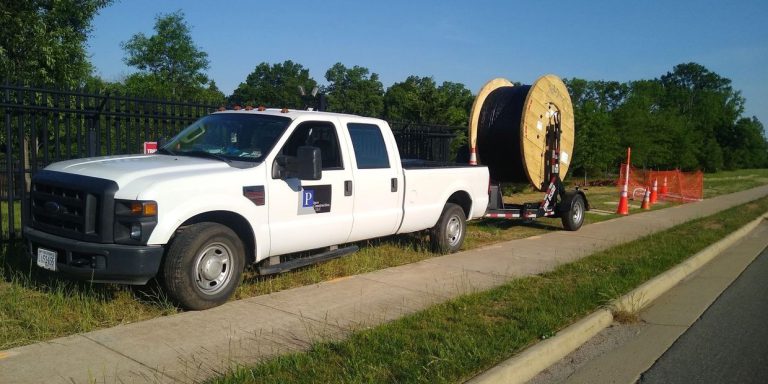


Pre-Installed Fiber Cable in HDPE Duct: 1,500 km West African Oil Pipeline
ZTO Cable supplied 1,500 km of factory-pre-assembled HDPE duct with the fiber cable already inside — a configuration known as Cable-in-Conduit (CIC) — for an oil pipeline monitoring project in West Africa. The contractor laid the pipeline and the fiber cable in the same trench pass, and the operator commissioned DTS and DAS monitoring on the same construction season.

The Project
The pipeline crosses semi-arid West African terrain: daytime soil temperatures above 60 °C, seasonal flooding, active termite populations, and a cathodic protection system that can generate hydrogen harmful to standard fiber. The operator needed continuous monitoring along 1,500 km of trunk pipeline — distributed temperature sensing (DTS) for leak and hot-tap detection, distributed acoustic sensing (DAS) for third-party intrusion, and SCADA backhaul for remote valve stations.
For an overview of how distributed sensing works on pipelines and the cable requirements behind it, see our guide to fiber optic cable for oil and gas pipeline monitoring.
The Cable-in-Conduit Solution

ZTO Cable supplied the cable-in-conduit on continuous wooden reels, factory-pre-lubricated, in single lengths up to 4 km. Each reel contained a 40/33 mm HDPE duct to ASTM D3350 PE4710 classification with SDR 11 wall, a permanently lubricated silicon-core innerduct, and a 24-fiber GYTS-type armored loose-tube cable in standard G.652D single-mode. For the deeper sections of the route through high water-table zones, the equivalent direct-buried GYTS33 construction was substituted. See our Stranded Loose Tube Armored Fiber Optic Cable GYTS for the standard product, and the direct-buried GYTS33 for the deeper sections.

The pre-installed assembly allowed the contractor to lay pipeline and fiber cable in a single trench pass — no second mobilization for cable blowing, no open duct at risk of water or dirt ingress between construction stages. For remote African corridors where mobilizing a blowing compressor is a logistics problem in itself, this is increasingly the default method. See our ADSS cable for African markets guide for related deployment considerations on overhead builds.

Outcome
Across 1,500 km, the CIC method kept the fiber monitoring system on pace with the pipeline construction spread. Joints were limited to factory-controlled lengths and station-approach splices. OTDR commissioning traces were within the loss budget specified for DTS/DAS performance on every reel, and the operator was able to begin baseline acoustic and thermal surveys during the same construction season as mechanical completion.
The HDPE duct, silicon-core innerduct, and GYTS-type armored fiber combine to give a verified 25-year service life under the same soil conditions encountered on this route — termite exposure, cathodic-protection hydrogen, and ground temperatures from −40 °C to +70 °C.
If you are planning a pipeline fiber monitoring system or a long-distance oil and gas communications corridor, ZTO Cable can engineer the cable-in-conduit to your reel lengths, fiber count, and duct dimensions. Every outdoor cable we manufacture ships with 100 % OTDR test reports.
- 1,500 km of pre-installed fiber cable in HDPE duct, delivered on 4 km reels.
- One-pass installation — pipeline and fiber cable laid in the same trench.
- DTS and DAS ready — 24-fiber G.652D single-mode cable, GYTS / GYTS33 armor.
- 25-year service life — HDPE duct to ASTM D3350 with permanent silicon-core lubrication.


Planning a Pipeline Fiber Project?
Send us your pipeline route length, fiber count, and the soil / climate conditions. ZTO Cable’s engineering team will return a CIC specification, reel-length plan, and OTDR-tested sample reel for evaluation.
Contact Our Engineering Team →